

We don’t talk enough about men and work-life balance, not the way women have been talking about it for decades, with the same honesty and the same stakes. We have a whole vocabulary for what overwork costs women, what it costs families, what it costs the woman quietly managing everything at the margins. But the conversation about what total absorption into work costs men is much quieter. The friendships that dissolve, the children who learn not to interrupt, the self whittled down to professional function. That conversation tends to happen in softer rooms, if it happens at all.
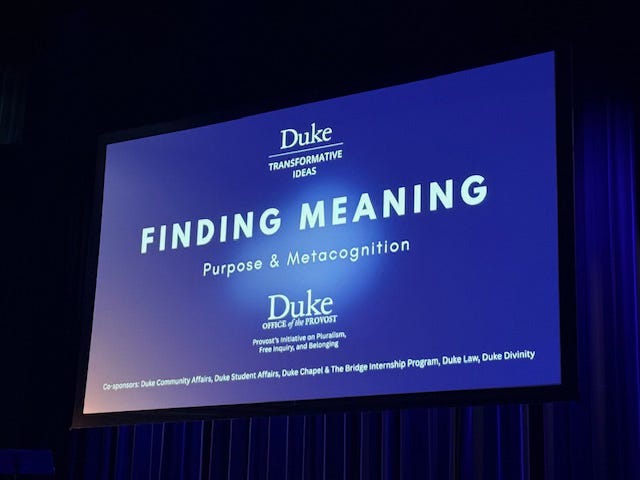
A few weeks ago I was at a conference at Duke built around meaning, loneliness, and what it looks like to live well in a time when both feel harder to hold. Arthur Brooks was there and Iain McGilchrist was there, and it was the kind of conversation that follows you home on the plane and sits with you at the kitchen table for days.
Brooks has written about how men in America are unlikely to form new friendships after thirty, how work becomes not just what they do but who they are, the last remaining structure of identity. He has a phrase for the shallow relationships that fill the space, “deal friends,” built on transaction and utility rather than genuine sustenance. His worry is that we have normalized a version of male life in which depth gets steadily traded for productivity, and no one calls it loneliness because it doesn’t look like loneliness from the outside.
McGilchrist arrived somewhere nearby from a different direction. He talks about two kinds of attention, one narrow and grasping, oriented toward getting and using, the other open and patient, oriented toward connection and what actually matters. His worry is that we have built a world rewarding the first almost exclusively while quietly starving the second, and that meaning doesn’t come from optimizing your life but from staying genuinely present to it.
I flew home thinking about Shabbir.
He has returned to work, gradually, the way you ease back into cold water. A meeting here, a conversation there, the slow reopening of a professional self that had been suspended, not erased. Researchers who study cancer survivors say this is one of the most psychologically significant moments in recovery, not the end of treatment but the return to a role that tells you who you are outside of illness. You are more than a patient. Work, at its best, gives that back. And I can see it in him, the way his energy sharpens after a good call, the way a difficult problem seems almost nourishing.
But what the research also shows, and what feels true from lived experience, is that the person who returns to work after something like this is not the same person who left. Illness strips life down to its essentials. It clarifies, sometimes brutally, what was actually central and what only pretended to be. And the question that follows a survivor back into the office, whether they name it or not, is whether they can carry that clarity with them or whether the old grooves will quietly reopen.
For men especially, those grooves run deep. The culture has long treated professional absorption as a kind of nobility. He is focused, driven, carrying a lot. The hours disappear around him and this gets narrated as seriousness rather than partial absence. The home adapts, the children learn the shape of maybe later, and the woman across from him becomes, slowly, more infrastructure than companion. I watched versions of this in other families. I watched it, in different ways, in ours.
What illness did was interrupt that story without asking.
I’ve written about some of what shifted this past year. How I watched Shabbir become present in ways I had wanted for years and given up asking for. The year was enormous. And what gets clarified that way, you can’t unsee.
The question I find myself sitting with now is not whether Shabbir can do it, he can, but whether the reentry becomes a genuine new chapter or just a gradual slide back into old patterns dressed in new gratitude. I watch this with hope and wariness held together, and I think that’s the honest place to be.
Families are porous, and work doesn’t stay in its lane. It shapes the emotional weather of a house. This is why I’ve never been able to take the language of balance lightly, even when it gets used so casually it sounds like lifestyle branding. Balance is not a cute aspiration. It’s an ethical question about what kind of presence we owe each other.
I keep coming back to what McGilchrist was describing at that conference, that we can pay such narrow, consuming attention to one part of our lives that we lose access to the wider world that gives it meaning, that we mistake the getting and the doing for the thing itself. Women know something about the opposite of that, even without the language for it. We know what it is to think in fragments, to carry six lines of attention at once, to long for an hour not already claimed by someone else’s need and to watch a meaningful life quietly reduce itself to maintenance if we’re not careful.
After a year like ours, none of this feels abstract. It feels domestic. Marital. Spiritual, even.
I don’t have neat answers for what comes next. I only know that this season has made me suspicious of any version of success that requires us to become less available to wonder and to each other. Some evenings I watch Shabbir moving between things that once seemed impossible to hold together, work and recovery and fatherhood and the quiet pleasure of an ordinary day, and there is so much gratitude in that image alongside something in me that stays quietly attentive. Not fearfully. Just honestly.
Survivorship, I’ve come to understand, is not about returning to the person you were before. It’s about figuring out who you are now, and choosing carefully what gets to occupy the center.
What a beautifully-written, thoughtful reflection. It sounds like your family has been through a lot. Thank you for sharing!